Sometimes the feelings that matter most are the hardest to put into words.
Maybe you've sat across from someone and known exactly what you felt but couldn't find a way to say it. Maybe your child comes home from school shut down and quiet, and when you ask what's wrong, all you get is "nothing." Maybe you've been carrying something for years and the thought of talking through it out loud feels like too much.
Sand tray therapy was built for exactly those moments.
It's one of the modalities we use most often here at Mending Minds, and it's one of the most effective tools we have — for children, for teens, and for adults who are surprised to learn it isn't just for kids.
How Sand Tray Therapy Works
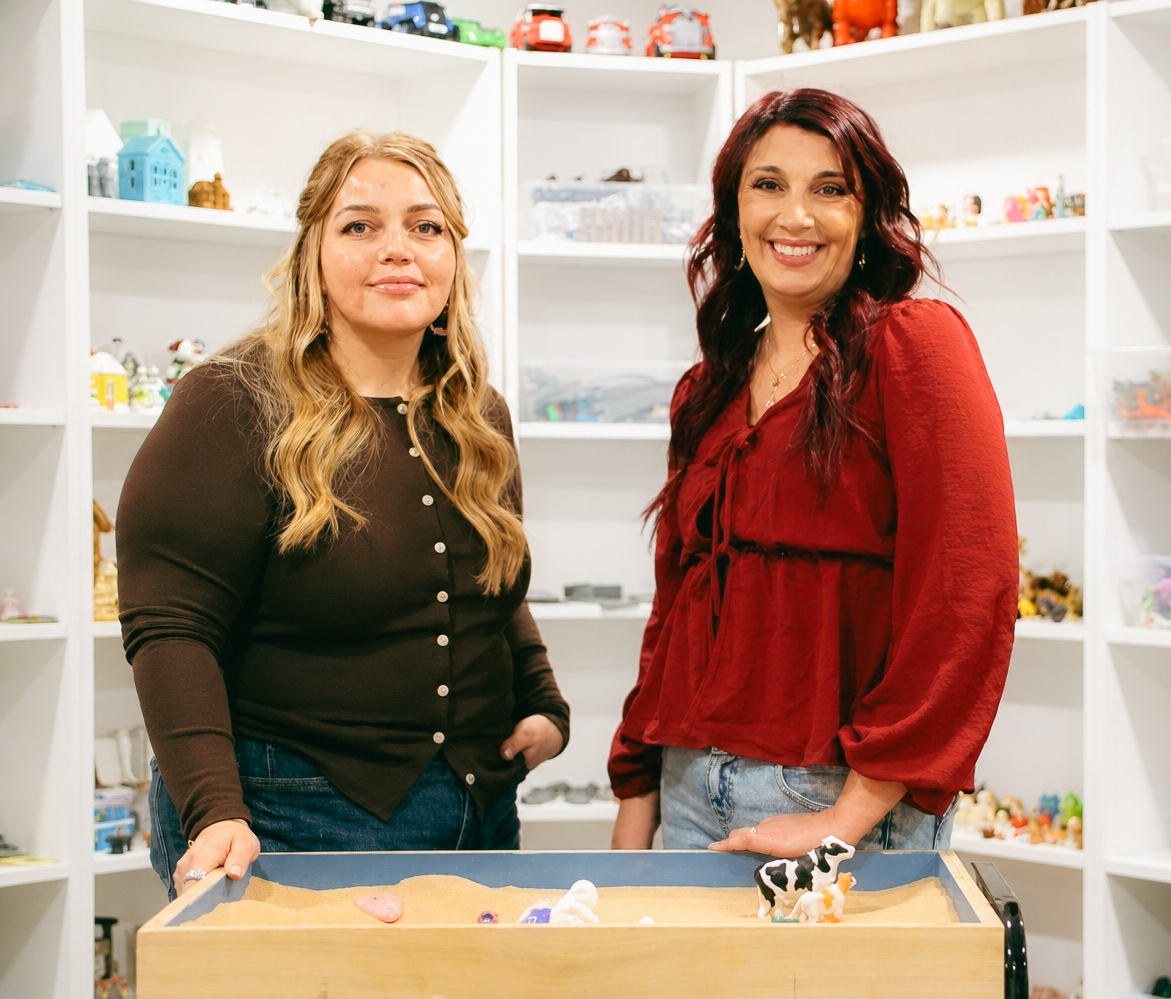
The setup is simple. You're given a tray of sand and access to a collection of miniature figures — people, animals, buildings, trees, fences, bridges, symbolic objects. Hundreds of them. You choose whichever pieces feel right and arrange them in the sand however you want.
There's no right way to do it. No instructions. No test you can fail. Your therapist is present, attentive, and nonjudgmental — but they're not directing the process. The scene you create is yours.
What happens next is where the work begins.
The world you build in the tray reflects what's happening inside you — often in ways you didn't expect and couldn't have articulated with words alone. Barriers show up as walls and fences. Isolation shows up as a figure standing apart. Conflict shows up as opposing groups. Safety shows up as enclosures, shelters, or protective figures nearby.
Your therapist helps you explore what you've created. Not by interpreting it for you, but by asking gentle questions and holding space for whatever comes up. The sand tray becomes a bridge between what you feel and what you can understand — and eventually, what you can begin to work through.
It's Not Just for Kids
This is the most common misconception about sand tray therapy, and it keeps a lot of adults from experiencing something that could genuinely help them.
Yes, sand tray therapy is powerful for children. Kids often don't have the vocabulary or developmental capacity to articulate complex emotions, and the sand tray gives them a language that doesn't require words. A child who can't tell you they feel unsafe at school can show you — and a trained therapist can read what the tray reveals.
But adults benefit just as much, sometimes more. Trauma, grief, anxiety, relationship pain — these things live in parts of the brain that don't always respond well to traditional talk therapy alone. Sand tray therapy engages the nonverbal, sensory, and symbolic parts of the mind. It accesses emotions and memories that conversation might circle around for months without reaching.
If you've ever felt like you're "stuck" in therapy — like you understand the problem intellectually but can't seem to move past it emotionally — sand tray work can break through that wall.
Who Benefits from Sand Tray Therapy?
Sand tray therapy isn't limited to one issue or one age group. At Mending Minds, we use it with clients across a wide range of experiences.
Children and teens who are struggling with anxiety, behavioral changes, family transitions like divorce or blending, bullying, grief, or experiences they don't have words for yet.
Adults processing trauma — including sexual trauma, childhood experiences, combat-related stress, domestic violence, or any event that left a lasting mark. Sand tray therapy is especially effective alongside EMDR, which several of our clinicians are trained in.
Individuals navigating grief and loss. Creating a scene in the tray can give shape to feelings of absence, longing, and the complicated emotions that come with losing someone — whether through death, estrangement, or life changes.
People who feel stuck. If talk therapy has been helpful but you sense there's something deeper you haven't been able to access, sand tray work can open doors that conversation alone hasn't reached.
Anyone who processes better through doing than talking. Some people are wired to think through their hands. Sand tray therapy meets them there.
The Research Behind It
Sand tray therapy isn't a fringe technique or an arts-and-crafts exercise. It's an evidence-informed modality grounded in decades of clinical research and practice.
Its roots trace back to the work of Dora Kalff, who developed sandplay therapy in the 1950s and 1960s based on Jungian principles. Since then, it has evolved into a widely practiced approach used in clinical settings worldwide. Research supports its effectiveness for reducing anxiety, processing trauma, improving emotional regulation, and enhancing self-awareness — across all age groups.
The therapeutic mechanism is grounded in neuroscience. Trauma and strong emotions are often stored in the right hemisphere of the brain — the side that processes images, sensations, and spatial relationships rather than words. Sand tray therapy engages that hemisphere directly, allowing clients to access and process experiences that verbal therapy alone may not reach.
Multiple of our clinicians at Mending Minds are certified in sandtray techniques, meaning this isn't something we dabble in — it's a core part of how we practice.
What to Expect at Your First Sand Tray Session
If you've never done sand tray therapy before, here's what a typical session looks like at Mending Minds.
Your therapist will introduce you to the sand tray room and the collection of miniature figures. You'll have time to look through them, touch them, and get comfortable. There's no rush.
When you're ready, your therapist will invite you to create a scene — a world, a story, an arrangement, whatever feels right. Some people work quickly and intuitively. Others take their time. Both are fine. There is no correct approach.
Once you've placed your figures, your therapist will sit with you and the tray. They might ask you to describe what you see. They might ask how certain figures feel, or what the space between two objects represents. They might simply be quiet with you while you take it in.
The session unfolds at your pace. Some clients experience emotional breakthroughs in their first sand tray session. Others build understanding across several sessions as patterns and themes emerge. Your therapist will help you make sense of what comes up — gently, without pressure, and at the speed that feels safe.
Certified Clinicians Who Know This Work
Sand tray therapy is only as effective as the person facilitating it. At Mending Minds, multiple members of our clinical team are certified in sandtray therapy, including our lead therapist Kendra Jones, CMHC. Our clinicians don't just offer sand tray as an option — they've invested in specialized training and certification because they've seen what it can do.
We combine sand tray work with other evidence-based modalities including EMDR, somatic experiencing, brainspotting, and trauma-informed care. Every treatment plan is tailored to you — not a formula, not a script, but a collaborative approach built around what you actually need.
You Don't Have to Have the Right Words
That's the whole point. Sand tray therapy meets you where you are — even when "where you are" is a place you can't quite describe.
If you've been thinking about therapy but the idea of sitting across from someone and talking about everything feels overwhelming, this might be a better starting point than you think. And if you're already in therapy but feel like something deeper is waiting to be reached, sand tray work might be the key.
Schedule a free consultation or call (435) 263-0254. We're at 88 E Fiddlers Canyon Rd, Suite 110, in Cedar City — serving individuals, couples, and families across Iron County and Southern Utah.
You don't have to do this alone. And you don't have to have the words yet.
Sand tray pairs especially well with Internal Family Systems (IFS) therapy and EMDR therapy — both available at Mending Minds in Cedar City and via telehealth across Utah.
Frequently Asked Questions
Is sand tray therapy only for children?
No. While sand tray therapy is excellent for children and teens, it's equally effective for adults. It engages nonverbal, sensory processing that can help adults access emotions and trauma that talk therapy alone may not reach.
Do I need to be artistic or creative to do sand tray therapy?
Not at all. There's no artistic skill involved. You simply choose miniature figures and place them in sand. There's no right or wrong way to arrange them — your therapist guides the process from there.
How many sessions does sand tray therapy take?
It varies. Some clients experience breakthroughs in a single session. Others benefit from sand tray work across multiple sessions as themes and patterns develop. Your therapist will discuss what makes sense for your goals.
Can sand tray therapy help with trauma?
Yes. Sand tray therapy is widely used for trauma processing, including childhood trauma, sexual assault, combat-related stress, and grief. It's often combined with EMDR and other trauma-focused modalities for a comprehensive approach.
Is sand tray therapy covered by insurance?
Sand tray therapy is conducted as part of a standard therapy session. If your insurance covers counseling at Mending Minds, it covers sand tray work within those sessions. Contact us at (435) 263-0254 to verify your coverage.