At Mending Minds, we believe that accessing mental health care should not be another source of stress. Finding the right therapist can already feel overwhelming, and understanding insurance coverage can make the process even more complicated.
We want to be transparent with our community about the challenges surrounding mental health insurance, the changes happening in healthcare, and what these changes may mean for you.
Why Is It So Difficult to Use Insurance for Therapy?
Having health insurance does not always guarantee easy access to mental health services.
Insurance companies establish provider networks, determine reimbursement rates, and set requirements for participating therapists. Sometimes, an insurance company may not accept additional providers into its network, even when those providers are qualified and willing to participate.
This creates a frustrating situation: a person may have mental health benefits but still struggle to find an available therapist who accepts their specific plan.
Mental health professionals have also reported challenges involving reimbursement rates, administrative requirements, and payment delays. These concerns can affect providers' ability to participate in insurance networks and, ultimately, the options available to clients.
What About Recent Changes in Healthcare Policy?
Mental health insurance coverage is protected by federal laws, including the Mental Health Parity and Addiction Equity Act. Generally, this law requires covered health plans that offer mental health benefits to treat those benefits comparably to medical and surgical benefits.
However, recent federal policy and enforcement changes have created additional questions about how these protections will be implemented.
In 2025, federal agencies announced that they would not enforce certain newer mental health parity regulations while those rules undergo legal review. Importantly, the underlying federal parity protections remain in place.
These developments are worth paying attention to, but they do not mean that insurance companies can simply stop covering mental health treatment.
Understanding Your Insurance Benefits
When looking for therapy, it is helpful to understand a few important distinctions:
- In-network: Your therapist participates in your specific insurance network.
- Out-of-network: Your therapist does not participate in your network, although your plan may offer some reimbursement.
- Deductible: The amount you may need to pay before certain insurance benefits begin.
- Copay or coinsurance: Your portion of the cost of a covered appointment.
- Credentialing: The process insurance companies use to review providers' qualifications before allowing them to participate in a network. Credentialing and contracting are related but distinct processes.
Coverage can vary significantly, even between plans offered by the same insurance company.
Insurance at Mending Minds
At Mending Minds, we are committed to helping clients understand their insurance benefits and navigate the process of accessing mental health care as easily as possible.
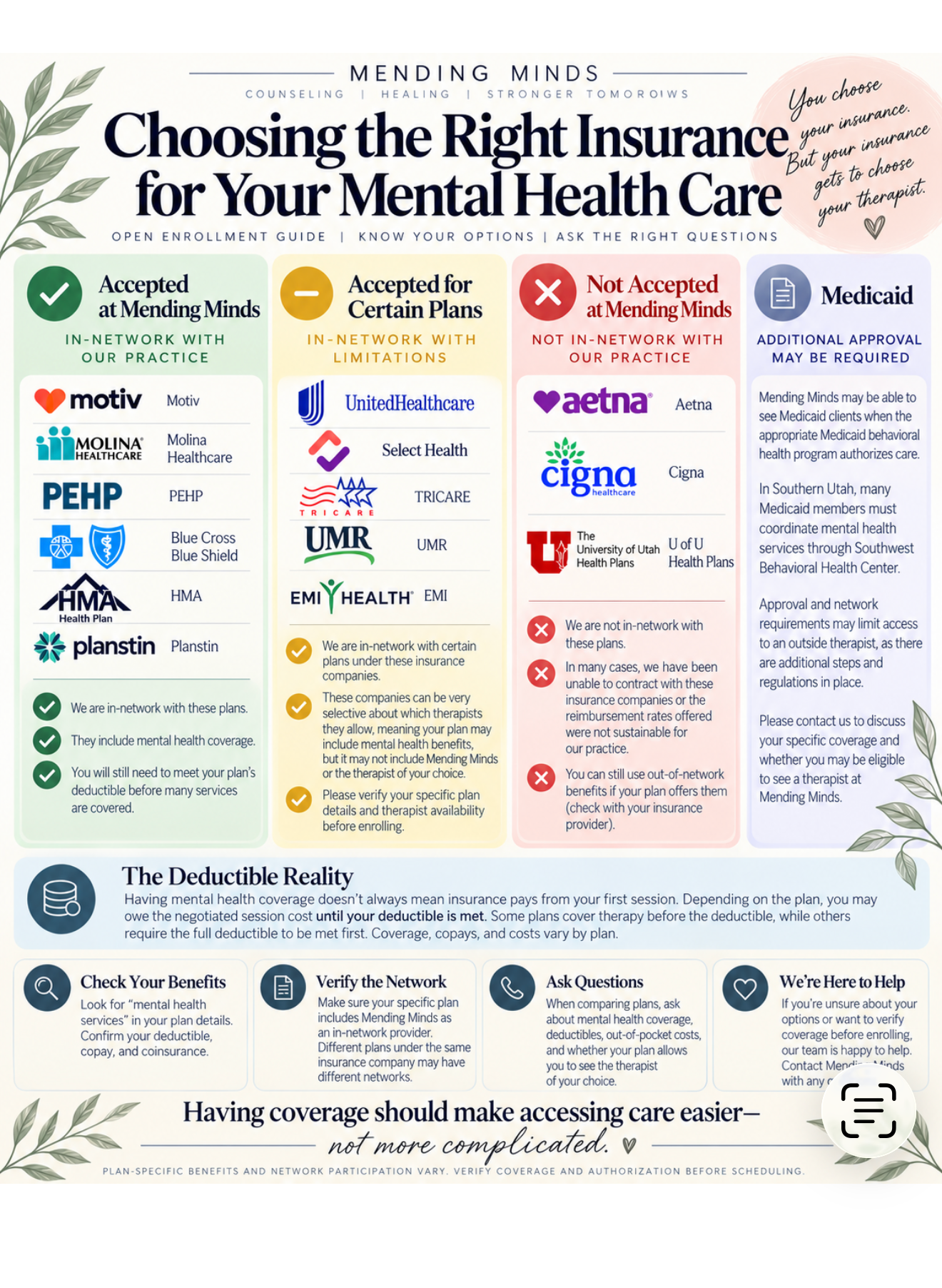
You choose your insurance. But your insurance gets to choose your therapist.
Where each plan stands with Mending Minds:
Accepted
In-network with our practice- Motiv
- Molina Healthcare
- PEHP
- Blue Cross Blue Shield
- HMA Health Plan
- Planstin
We are in-network with these plans, and they include mental health coverage.
You will still need to meet your plan's deductible before many services are covered.
Accepted for Certain Plans
In-network with limitations- UnitedHealthcare
- SelectHealth
- TRICARE
- UMR
- EMI Health
Depends on your specific plan. These companies can be selective about which therapists they allow, so your plan may include mental health benefits but not Mending Minds or the therapist of your choice.
Please verify plan details and therapist availability before enrolling.
Not Accepted
Not in-network with our practice- Aetna
- Cigna
- University of Utah Health Plans
We are not in-network with these plans. In many cases we have been unable to contract with them, or the reimbursement rates offered were not sustainable for our practice.
You may still be able to use out-of-network benefits if your plan offers them. Check with your insurance provider.
Medicaid
Additional approval may be required- Utah Medicaid Behavioral health program authorization required
- Southwest Behavioral Health Center Coordinates most Southern Utah Medicaid mental health services
Approval comes first. Mending Minds may be able to see Medicaid clients when the appropriate Medicaid behavioral health program authorizes care.
Network rules and extra steps may limit access to an outside therapist. Contact us to discuss your coverage and eligibility.
The Deductible Reality
Having mental health coverage doesn't always mean insurance pays from your first session. Depending on the plan, you may owe the negotiated session cost until your deductible is met. Some plans cover therapy before the deductible; others require the full deductible first. Coverage, copays, and costs vary by plan.
Because insurance participation and benefits can change, we encourage clients to contact our office to verify coverage before scheduling an appointment.
What if we don't accept your insurance?
Not accepting a particular insurance plan does not necessarily mean your insurance does not cover mental health services.
In some cases, insurance companies may decline to contract with additional mental health providers, even when those providers are qualified and willing to participate in their networks.
This distinction matters. A therapist may be ready and willing to accept your insurance but unable to become an in-network provider because the insurance company has declined their application or is not accepting additional providers.
Our Commitment to Accessible Mental Health Care
We recognize how discouraging it can feel to seek mental health support only to encounter financial, administrative, or insurance-related barriers.
At Mending Minds, we believe access to mental health care should be determined by a person's needs, not unnecessarily complicated insurance processes.
While we cannot control insurance companies' credentialing decisions, network participation requirements, or reimbursement policies, we remain committed to transparency, advocacy, and helping clients understand their options.
Mental health care is healthcare, and access to it matters.